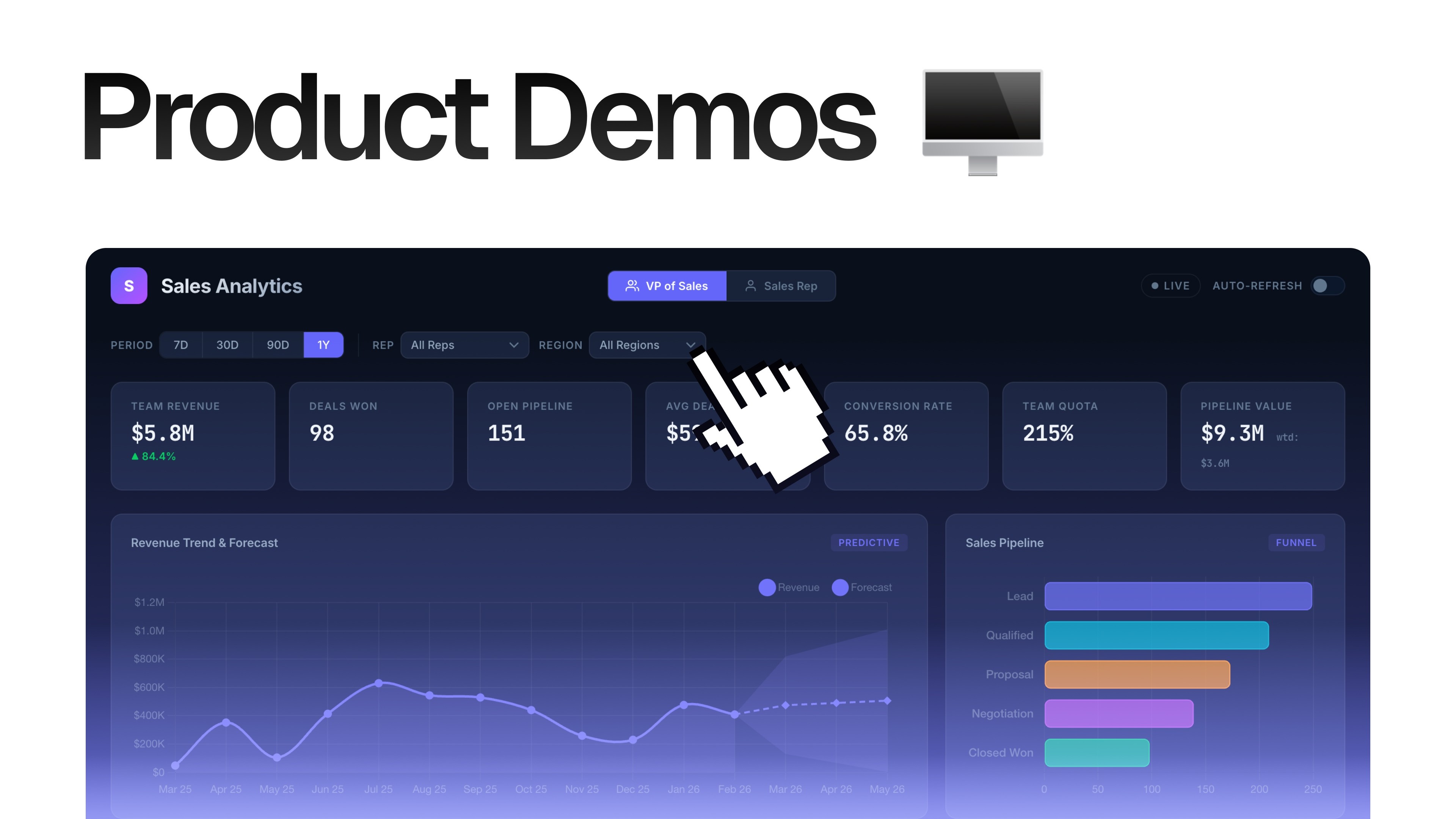
I've worked in product design long enough to see the same mistake play out over and over. A team spends months building something genuinely useful. The engineering is tight. The UX is solid. And then they hand it off to marketing, who writes a landing page full of feature lists, slap on a "Book a Demo" button, and call it a day.
Then they wonder why conversion is low.
Here's the thing — product demos work. Not the 45-minute sales call kind. The kind that shows your product in motion, solving a real problem, in the time it takes someone to finish a sip of coffee. That format converts. The problem is most companies either don't make them, or they make them badly.
Why Most Product Demos Fail
The average product demo has one of three problems — and sometimes all three at once.
The first is leading with features instead of outcomes. Nobody buys a feature. They buy a result. A demo that walks through the settings panel before showing what the product actually does has already lost the viewer.
The second is length and pacing. Attention is expensive. If your demo is eight minutes of screen recording with a voiceover in a monotone, most people are gone by minute two. The best demos are tight, purposeful, and move fast.
The third — and the one nobody talks about — is that most demos aren't designed. There's a big difference between hitting record and showing your product, and actually crafting a demo experience. The framing, the pacing, the visual hierarchy — all of it matters. A product demo is a piece of content. It needs to be treated like one.
The UX Problem Nobody's Talking About
Here's something most marketing teams don't think about: a product demo is a UX problem.
You're designing an experience for a viewer who is skeptical, distracted, and has three other tabs open. The goal isn't to show everything your product does. The goal is to make them feel that this product solves their problem. That's a design challenge.
It requires understanding the user's mental model before they ever see your UI. It requires sequencing information in a way that builds toward a payoff. It requires knowing which moments to slow down on, and which to cut entirely.
Most video agencies don't think this way. And most UX teams aren't thinking about the demo as part of the product experience at all. That gap is where demos go to die.
What a Good Product Demo Actually Looks Like
A great demo does four things in order, and fast.
First, it names the pain. In the first few seconds, your viewer should feel seen. You're describing a problem they already know. This is the hook, and it earns you the next 60 seconds.
Second, it shows the solution in motion. Not described. Not bulleted. Shown. The product doing the thing it does, in a context that's recognizable to the viewer.
Third, it makes the outcome visceral. What does life look like after they use this? What did they just save — time, money, stress? Make it concrete. Make it land.
Fourth, it gives them a clear next step. Every demo needs a frictionless CTA. Something they can act on right then and there.
I apply this same structure to YouTube content. Every video is essentially a product demo — you're showing someone how a tool or workflow actually works and making them feel the value of it in real time. The overlap is bigger than most people realize.
Why the Designer-Creator Combination Matters
If you're thinking about commissioning demo content, here's the question I'd ask before hiring anyone: do they think like a product designer or like a video producer?
Because those are different skill sets, and you need both.
A video producer thinks in visual effects and timelines. A product designer thinks in user goals, information hierarchy, and what the viewer is actually trying to understand. The best demo content comes from someone who can do both — who can look at your product and immediately identify the two or three moments that need to land, then build a visual sequence around those moments.
My background is in UX and product design. But I've also spent years making content that actually has to work — that has to hold attention, communicate clearly, and move people toward an action. That combination is what makes demo content effective instead of just polished.
Who This Is For
If you're building a SaaS product, an AI tool, or anything with a UI that needs to communicate its value — this applies to you.
Specifically, it matters most if your landing page isn't converting the way it should (people are landing, looking, and leaving — a well-made demo often fixes this without touching a word of copy), if your sales cycle involves explaining the product too much, or if you're launching something new and need to make it feel real (a concept is hard to buy, but a demo makes it tangible).
The Takeaway
Most products have a communication problem. The product works, but people just can't feel that from the outside.
A product demo, done well, closes that gap. It lets someone experience the value of your product before they've paid anything. And in a world where attention is expensive and trust is hard to earn, that's crucial for your marketing strategy.
If you want to see how I think about this stuff in practice, my YouTube channel is where I document it — tool by tool, workflow by workflow. And if you're working on something and want to talk through it, reach out. I take on a small number of projects and I'm always interested in interesting problems.